New Study: 43mm Robot Can Enter the Mouth for Tooth Preparation, Absolute Positioning Error Approximately 0.18mmIssuing time:2026-06-25 19:46
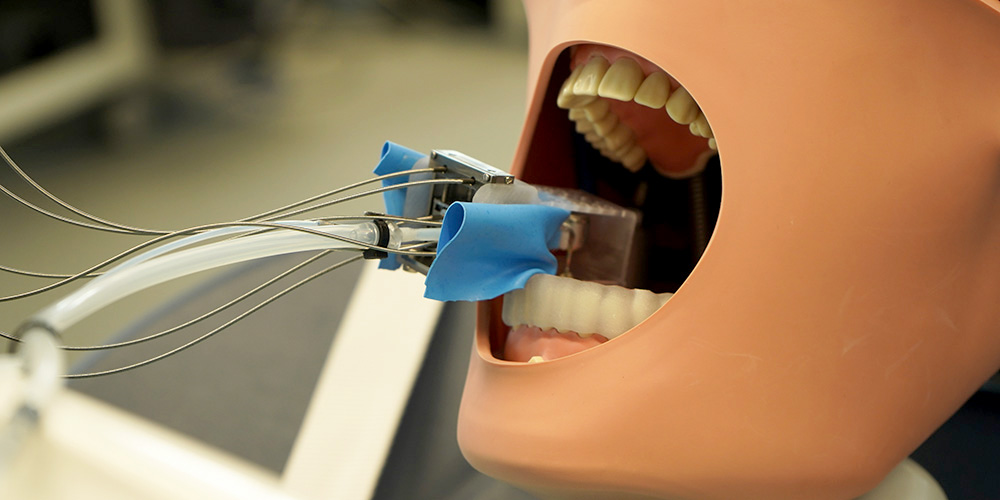
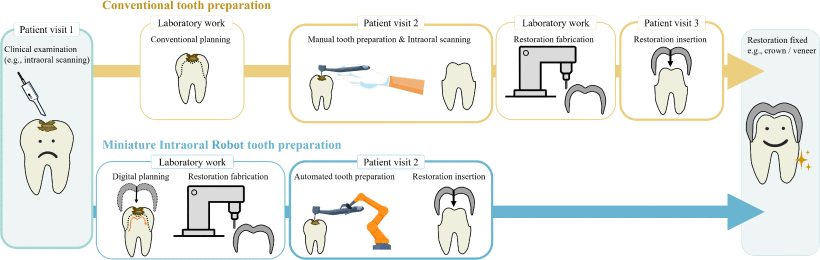
DentalGoodNews|A research team from the University of Basel released a prototype of the miniature intraoral robot "MIR" (Miniature Intraoral Robot) in June 2026, with the related paper published in "IEEE Transactions on Medical Robotics and Bionics". The overall dimensions of the robot are approximately 43.0×26.4×27.6 mm. In tests without an integrated internal position sensor, the average absolute positioning error was 0.18 mm. The research team believes it has the potential to reduce the number of visits required for dental crown restoration through a digital automated tooth preparation process. Researchers stated that the current conventional dental crown restoration process typically involves multiple visits: the dentist first removes carious tissue and completes tooth preparation, followed by intraoral scanning or impression taking, and fabricates a temporary restoration for the patient; after the permanent restoration is completed, the patient needs to return for cementation or seating. The developed miniature intraoral robot MIR envisions completing intraoral examination and scanning during the first visit, then designing the tooth preparation and fabricating the restoration based on a digital plan; during the patient's second visit, the robot performs tooth preparation according to the digital plan, after which the pre-fabricated restoration can be seated, potentially reducing waiting time and the number of follow-up visits in the traditional process.
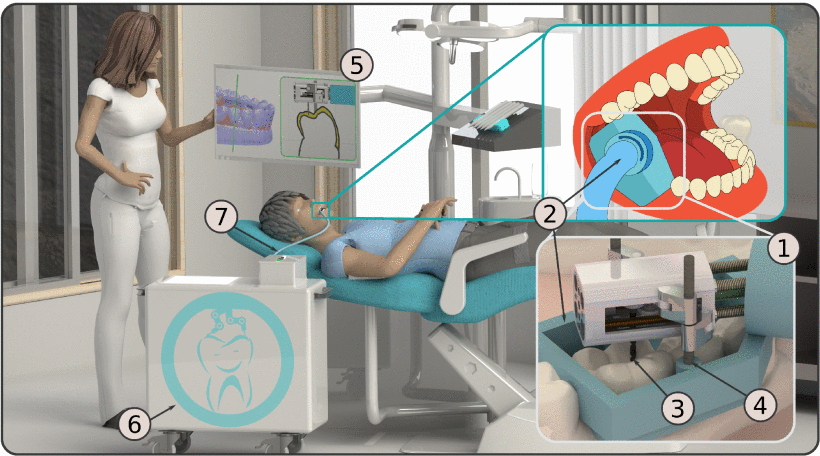
In terms of hardware design, the focus of MIR is on miniaturization, relative fixation within the oral cavity, and external actuation. The robot's motors and control system are placed outside the mouth, connected to the intraoral device via flexible drive shafts, cables, and tubing, making the intraoral part as compact as possible. MIR can be mounted on a customized occlusal fixation device or dental splint, meaning that even if the patient experiences slight head movements during treatment, the robot moves along with the patient's dentition, helping to maintain the relative position between the robot and the target tooth. Dr. Yukiko Tomooka stated that the design's original intention was to make the device small enough to adapt to the operating space within the oral cavity when the mouth is open. The research team conducted performance tests on MIR using synthetic resin teeth models and hybrid ceramic materials with hardness close to that of enamel. Test results showed that under open-loop control without an integrated position sensor, the average absolute positioning error of MIR was 0.18 mm, and the deviation between the actual ground surface and the planned surface was only 0.16 mm. Additionally, the force generated during grinding remained below 5 Newtons, approximately equivalent to the weight of a half-liter water bottle, which helps reduce thermal damage caused by frictional heat from excessive drilling force, lowering the risk of pulp devitalization.
Professor Georg Rauter, the project lead, pointed out that MIR is still in the experimental prototype stage. The next research step is to integrate sensors and cameras into the robot to monitor treatment progress and position in real time. This ensures that even in extreme situations such as power outages, the system can determine the current position through sensor data and clarify where to continue from. However, this study also has certain limitations: currently, MIR's tests were mainly conducted under test bench conditions, with the experimental subjects being artificial tooth models. Large-scale clinical validation in living human oral cavities has not yet been performed, and its performance in the real, complex intraoral environment with saliva interference remains to be further observed. This research was conducted in collaboration with the University of Basel, the Center of Dental Medicine at the University of Zurich, the University of Bern, and Camlog Biotechnologies GmbH, and was supported by the Swiss innovation agency Innosuisse.
【GOODNEWS】 Content for industry reference only (based on public info & professional judgment); not for decision-making. Readers bear full responsibility for their own judgment and risks.
Copyright © This Platform. Unauthorized reproduction & commercial use prohibited.
Errata, contributions & cooperation: Contact customer service via WeChat:HDSW_001
|
✉️
Subscribe to Our
Newsletter
We curate important stories and exclusive insights, delivered straight to your inbox.
In-depth analysis · Exclusive content · Fast-moving news
|