Teaching Research on Dental Interns: AI Lecture Group Scores Higher on Root Resorption Quiz, Higher Proportion of Self-Reported DistractionIssuing time:2026-11-13 11:43
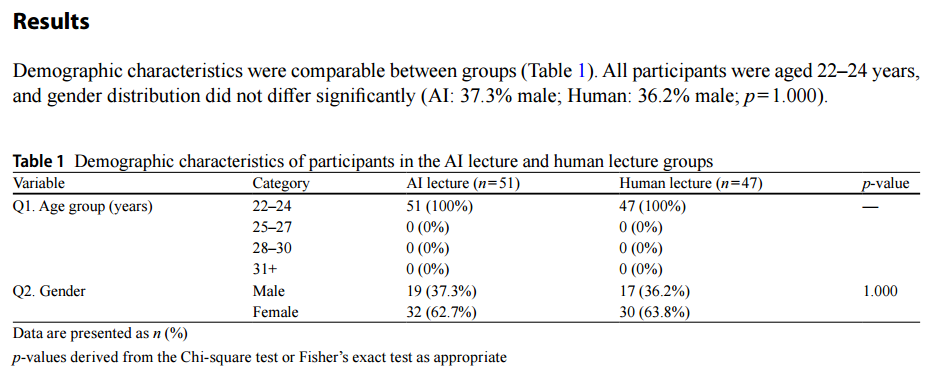
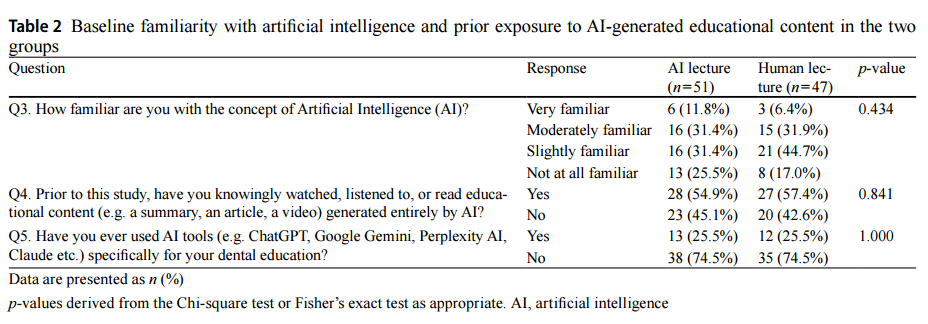
DentalGoodNews|Recently, a dental intern educational intervention study published online in BMC Medical Education showed that compared with live lectures by specialist physicians, video lectures generated using NotebookLM achieved higher mean scores on immediate post-lecture quizzes on the topic of root resorption (87.8% vs. 83.0%). However, the proportion of the AI group who self-reported being easily distracted during lectures was also significantly higher, reaching 74.5%, compared with 38.3% in the live teaching group. Researchers including Hamdan recruited 98 interns at a dental college in India and randomly divided them into an AI video lecture group of 51 and a live teaching group of 47. The two groups respectively studied three endodontic topics of increasing difficulty: diagnosis and treatment planning, vital pulp therapy, and root resorption, using the same journal articles, textbooks, and clinical guidelines as teaching materials. The live courses were taught by an endodontic specialist with more than 5 years of teaching experience; the AI group used the Video Overview function of Google NotebookLM to generate lecture videos based on the literature materials provided by the researchers. Each of the 3 courses lasted approximately 40-45 minutes and was conducted over 3 consecutive days. Immediately after each course, interns took a quiz containing 5 multiple-choice questions, for a total of 15 questions across the 3 courses. After all courses were completed, participants filled out a self-assessment questionnaire to evaluate the 3 lectures they had received overall. The immediate quiz results showed that for the two topics of endodontic diagnosis and treatment planning and vital pulp therapy, the differences in mean scores between the two groups did not reach statistical significance, with p values of 0.327 and 0.411, respectively. For the root resorption topic, the mean accuracy rate was 87.84%±9.86% in the AI group and 82.98%±11.78% in the live teaching group, with a statistically significant difference between groups (p=0.029). The researchers noted that because only one teaching topic was set at each difficulty level and the difficulty of the topics was not independently validated, this result may be related to the specific topic of root resorption, and it cannot yet be concluded that AI video lectures have a general advantage in advanced courses.
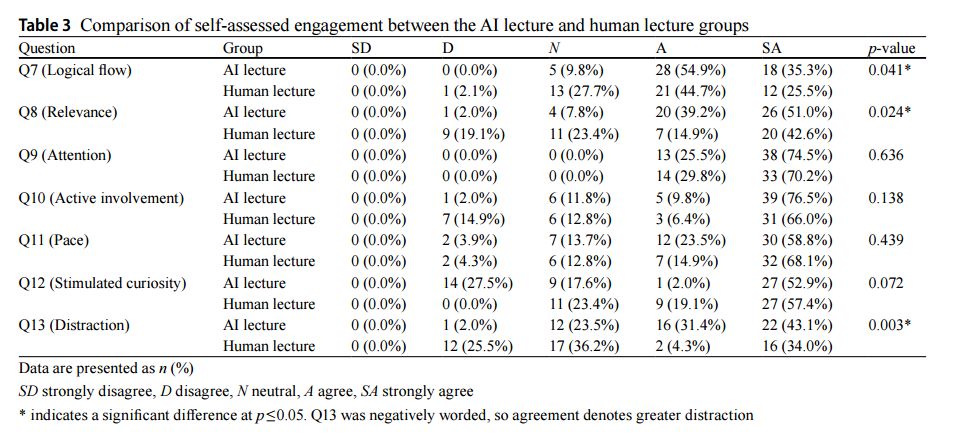
The self-assessment questionnaire showed that the AI group gave higher ratings on multiple items. There were statistically significant differences between the two groups in course logical coherence and the relevance of topics to internship training, with p values of 0.041 and 0.024, respectively. In addition, the AI group also rated teaching style, the content required for note preparation, and overall course satisfaction higher, with p values for between-group differences of 0.012, 0.010, and 0.006, respectively. The AI group also gave more positive evaluations on items such as post-course topic confidence, self-assessed clinical application ability, understanding of complex concepts, and achievement of learning objectives.
However, the two groups showed different results regarding attention. In the questionnaire, 74.5% of interns in the AI group agreed that they were easily distracted during lectures, compared with 38.3% in the live teaching group (p=0.003). The study has limitations: this single-center study included only one cohort of interns, and the actual number of participants in each group was below the at least 52 required by the sample size calculation; live teaching was also completed by only one teacher, making it difficult to rule out the influence of individual teacher factors. In addition, the study did not conduct a pre-course knowledge test, nor did it assess long-term knowledge retention or actual clinical performance. Therefore, post-course quiz scores can only reflect immediate knowledge acquisition and cannot be directly used as evidence of knowledge gain or improved clinical ability. The researchers believe that AI-generated video lectures achieved immediate quiz scores comparable to live lectures in some of the endodontic teaching content examined in this study, but their long-term teaching effectiveness still requires further research for verification.
Article classification:
Stomatology
【GOODNEWS】 Content for industry reference only (based on public info & professional judgment); not for decision-making. Readers bear full responsibility for their own judgment and risks.
Copyright © This Platform. Unauthorized reproduction & commercial use prohibited.
Errata, contributions & cooperation: Contact customer service via WeChat:HDSW_001
|
✉️
Subscribe to Our
Newsletter
We curate important stories and exclusive insights, delivered straight to your inbox.
In-depth analysis · Exclusive content · Fast-moving news
|