HKU Faculty of Dentistry and Harvard Medical School collaborate to develop moldable hydrogel that rapidly stops bleeding and promotes bone repairIssuing time:2026-10-20 11:58
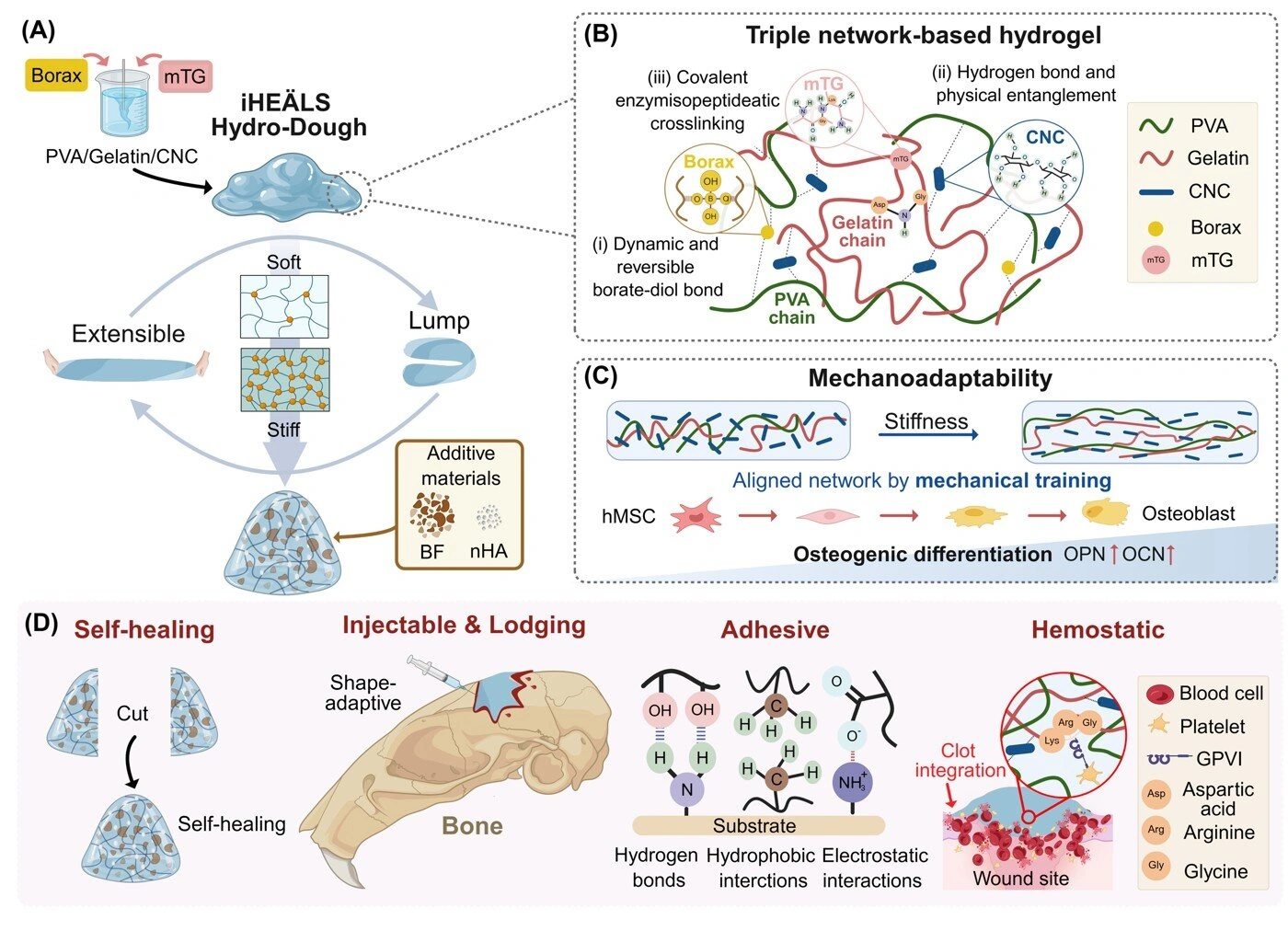
DentalGoodNews|Recently, a research team from the Faculty of Dentistry at the University of Hong Kong, in collaboration with a research team from Brigham and Women's Hospital, Harvard Medical School, developed and conducted preclinical validation of a shape-adaptive hydrogel, iHEÄLS, designed to address challenging clinical trauma scenarios such as severe hemorrhage, irregular bone defects, and comminuted fractures. According to the research team, inspired by the moldability of plasticine, this hydrogel can be shaped and adapted to irregular anatomical defects while simultaneously providing rapid hemostasis, strong tissue adhesion, self-healing capability, and mechanical elasticity—properties that are particularly important for emergency trauma care. The research team reported that the iHEÄLS material features a hierarchical three-layer network structure composed of polyvinyl alcohol, gelatin, and cellulose nanocrystals, crosslinked through dynamic boronate ester bonds and enzymatic covalent bonds. This molecular architecture endows the hydrogel with adaptability, self-healing properties, tissue adhesion, and mechanical integrity. As a result, the material can be shaped or delivered into irregular defects, enabling it to conform closely to complex anatomical structures without the need to reshape the defect to accommodate rigid implants. The research team at the HKU Faculty of Dentistry evaluated the material's hemocompatibility, biodegradation, tissue integration, and regeneration performance, with a focus on scenarios involving active hemorrhage and irregular or comminuted bone defects. In vivo studies showed that iHEÄLS achieved rapid hemostasis on bleeding bone surfaces and conformed to irregular cranial defects. When combined with autologous bone fragments, the hydrogel could contain and stabilize small bone fragments while supporting new bone formation; its degradation behavior was compatible with the regeneration process, with no obvious adverse tissue reactions observed. The research team believes that this technology may in the future be applied to scenarios such as severe facial trauma, comminuted craniomaxillofacial fractures, and emergency bone reconstruction where conventional implants or fixation methods are difficult to use. However, before clinical application, its safety, efficacy, and regulatory applicability still require further research to establish.
Article classification:
Stomatology
【GOODNEWS】 Content for industry reference only (based on public info & professional judgment); not for decision-making. Readers bear full responsibility for their own judgment and risks.
Copyright © This Platform. Unauthorized reproduction & commercial use prohibited.
Errata, contributions & cooperation: Contact customer service via WeChat:HDSW_001
|
✉️
Subscribe to Our
Newsletter
We curate important stories and exclusive insights, delivered straight to your inbox.
In-depth analysis · Exclusive content · Fast-moving news
|