New study: Ultrasound-activated piezoelectric nanospheres show potential for growth factor-free pulp-dentin regenerationIssuing time:2026-10-13 12:25
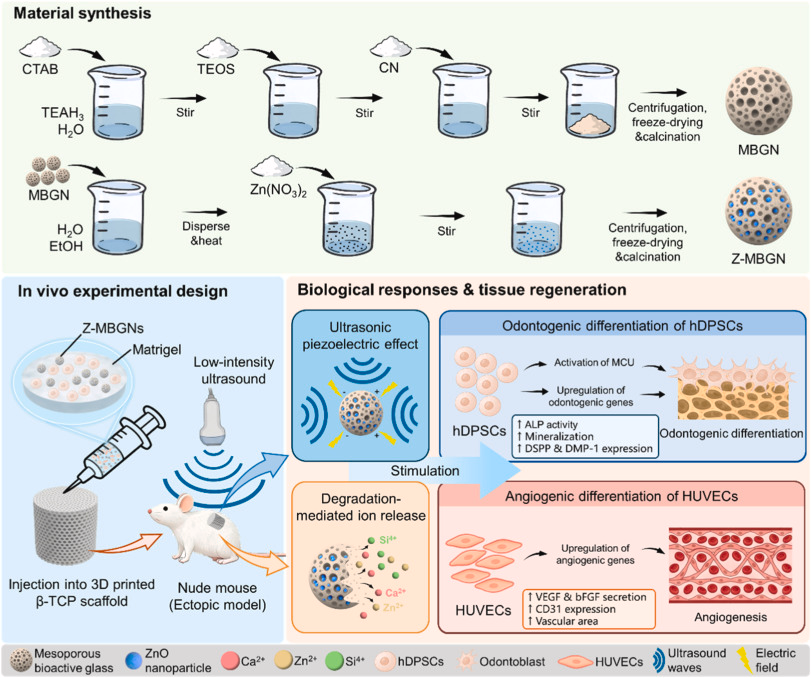
DentalGoodNews|Recently, Materials Today Bio published a cell and mouse experimental study exploring an ultrasound-activated nanomaterial that promotes processes related to pulp-dentin regeneration without the need for additional exogenous growth factors. The research team prepared nanoscale mesoporous bioactive glass microspheres incorporated with zinc oxide (Z-MBGNs). Under ultrasound irradiation, this material can generate electrical signals and continuously release zinc ions and calcium ions. After activation by low-intensity pulsed ultrasound (LIPUS), it promoted the odontogenic differentiation of human dental pulp stem cells (hDPSCs) and also enhanced the ability of human umbilical vein endothelial cells (HUVECs) to form vessel-like tubular structures. Dental pulp is the soft tissue inside the tooth containing blood vessels and nerves, encased externally by hard dentin, and the two together are called the pulp-dentin complex. The researchers focused on dentin formation and angiogenesis, two processes closely related to regeneration of the pulp-dentin complex. The team hoped to further provide electrical signals through ultrasound on the basis of ion release from the material, thereby simultaneously regulating these two types of cellular responses.
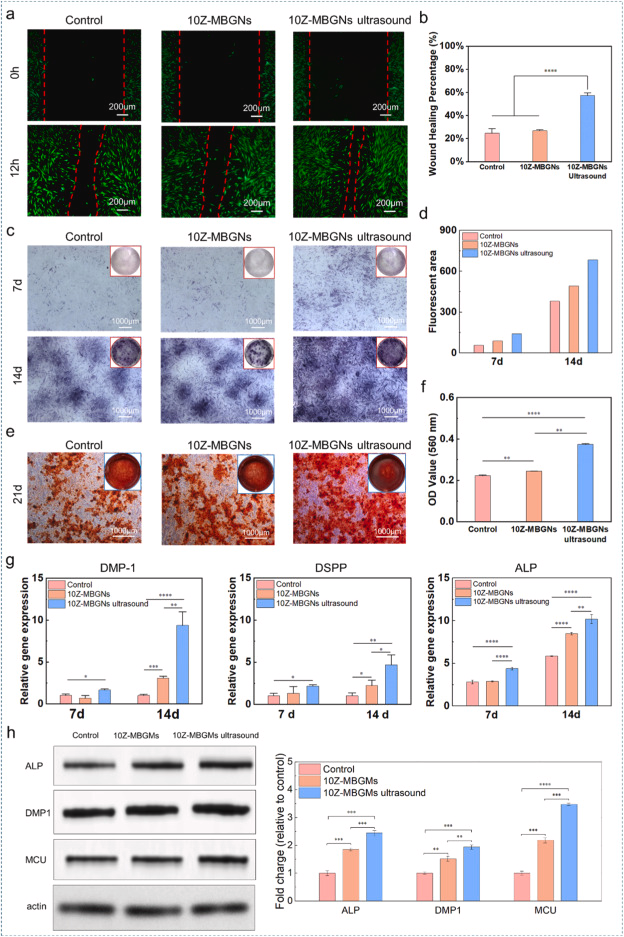
The team embedded zinc oxide into bioactive glass with a mesoporous structure, enabling sustained release of zinc and calcium ions and reducing the cytotoxicity caused by the rapid release of zinc ions when zinc oxide nanoparticles are used alone. In the L929 fibroblast cytotoxicity experiment, the version with a zinc oxide mass proportion of 10.24% (10Z-MBGN) showed a cell survival rate of 84.9%; the group with pure zinc oxide nanoparticles at the same zinc concentration showed 51.8%. In cell experiments, ultrasound-activated 10Z-MBGN promoted dental pulp stem cell migration, increased mineralized matrix (calcium salt deposition) formation, and also elevated the expression of dentin formation-related genes DSPP and DMP-1; the ability of vascular endothelial cells to form vessel-like tubular structures was enhanced, and the expression of angiogenesis-related indicators such as VEGF and bFGF was also elevated. The ultrasound parameters used in the experiment were 1 MHz, 400 mW/cm², and 50% duty cycle, with treatment for 5 minutes per day; the peak-to-peak value of the electrical signal generated by the material suspension under ultrasound was approximately 600 mV. The researchers also conducted a cell scratch assay, evaluating cell migration by observing the reduction in scratch area. After 12 hours, the scratch healing rate of the ultrasound plus 10Z-MBGN group was 57.3%, that of the nanosphere-only group was 26.7%, and that of the untreated control group was 23.6%.
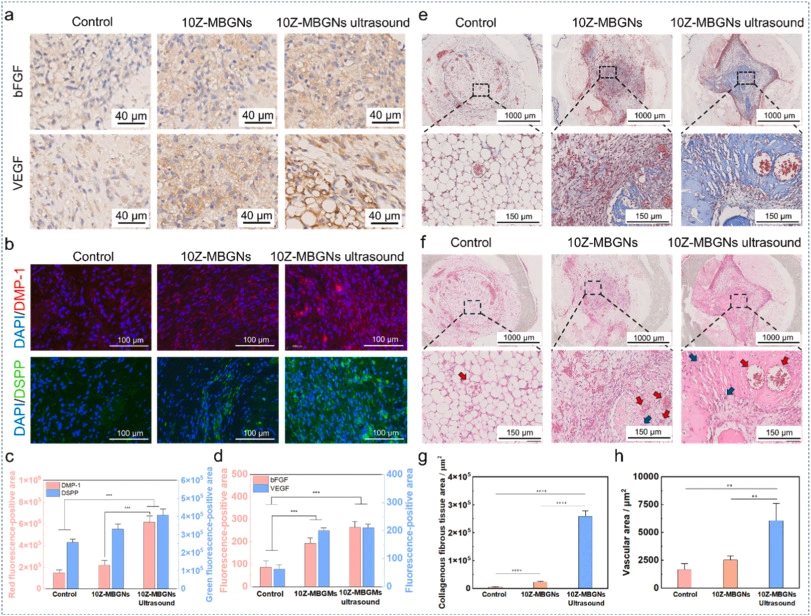
The researchers also implanted root-shaped β-tricalcium phosphate (β-TCP) scaffolds loaded with dental pulp stem cells, Matrigel, and 10Z-MBGN subcutaneously into nude mice, and administered ultrasound treatment daily for the first 7 days after implantation. The results showed that the ultrasound-treated group had increased extracellular matrix deposition, and higher levels of related indicators such as VEGF, bFGF, DSPP, and DMP-1 also appeared. At 6 weeks, Masson's trichrome staining showed that the collagen-positive area in the ultrasound group was approximately 56 times that of the control group and 11 times that of the 10Z-MBGN group that did not receive ultrasound. At the same time, histological observation found that odontoblast-like cells, mineralized tissue-like structures, and vessel-like structures appeared in the ultrasound group. In addition, the researchers noted that this study is still at the proof-of-concept stage, and the experiments only involved cell experiments and subcutaneous ectopic implantation in mice. The subcutaneous environment differs from the interior of a real tooth, so these results cannot yet prove that the material can fully regenerate a functional pulp-dentin complex inside a tooth; the experiment also did not include a ultrasound-only control group, making it difficult to distinguish whether the effects came from the material or from ultrasound itself; the mouse sample size was small, and no power analysis (a statistical method for estimating the required sample size in advance) was performed. The researchers stated that subsequent studies need to add mechanistic controls and validate in in situ tooth models in order to clarify the mechanism of action and translational potential.
【GOODNEWS】 Content for industry reference only (based on public info & professional judgment); not for decision-making. Readers bear full responsibility for their own judgment and risks.
Copyright © This Platform. Unauthorized reproduction & commercial use prohibited.
Errata, contributions & cooperation: Contact customer service via WeChat:HDSW_001
|
✉️
Subscribe to Our
Newsletter
We curate important stories and exclusive insights, delivered straight to your inbox.
In-depth analysis · Exclusive content · Fast-moving news
|