FDA Updates 510(k) Guidance for Dental Curing Lights and Composite Resin for the First Time in Two Decades.Issuing time:2026-09-04 20:16
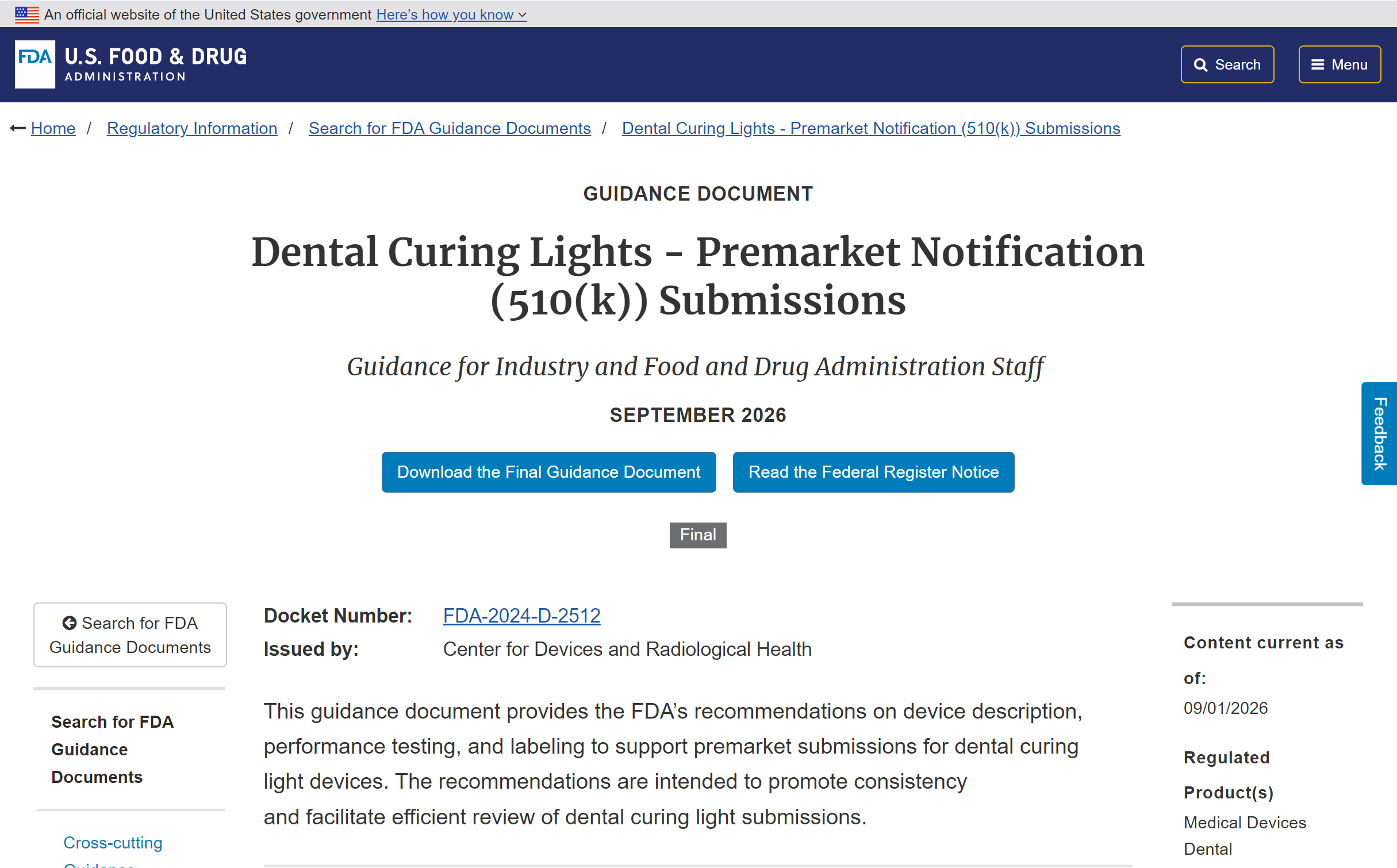
DentalGoodNews|September 2, 2026, the U.S. Food and Drug Administration (FDA) released the final guidance document "Dental Curing Lights - Premarket Notification (510(k)) Submissions" (hereinafter referred to as the "Guidance"), replacing the previous version from March 2006. This update marks the first systematic revision of technical review requirements in this field in nearly two decades, aimed at further clarifying review expectations and citing current consensus standards. According to the joint notice (Document No. 2026-17933) published in the U.S. Federal Register on the same day, the FDA concurrently released the final guidance document "Dental Composite Resin Devices - Premarket Notification (510(k)) Submissions" in the same batch of documents, replacing the previous version issued on October 26, 2005. Both guidance documents constitute significant annual updates to the 510(k) review requirements for dental devices. The Guidance explicitly applies to dental curing light devices subject to 21 CFR 872.6070 with product code EBZ, including curing lights employing broad-beam and monochromatic light sources, but excluding laser polymerization units and Class I exempt devices dedicated to whitening. In terms of device description, the FDA requires manufacturers to provide detailed component lists, internal engineering drawings, and light source parameters, with emphasis on comparing device differences and similarities in core parameters such as light intensity, radiant power, and peak wavelength. Regarding performance testing and safety, the Guidance sets forth the latest technical expectations. Non-clinical performance testing must provide data on radiant power output, light intensity distribution, thermal imaging, and maximum temperature rise during heat generation in accordance with ISO 10650. Electrical safety and electromagnetic compatibility (EMC) must comply with the currently FDA-recognized IEC 60601 series standards. For reusable patient-contact components, manufacturers must provide detailed reprocessing instructions in labeling, covering the full process of disassembly, cleaning, disinfection/sterilization, and reassembly. For biocompatibility evaluation, manufacturers should reference ISO 7405 or ISO 10993-1 standards to assess cytotoxicity, sensitization, and irritation responses. Additionally, devices involving software functions must submit software documentation at the appropriate level; devices meeting the definition of "cyber devices" must separately submit cybersecurity documentation; and devices integrating RF wireless technologies such as Bluetooth and Wi-Fi must also complete wireless compatibility testing. The composite resin guidance applies to tooth-colored resin materials under 21 CFR 872.3690 with product code EBF, as well as pit and fissure sealants and conditioning agents under 21 CFR 872.3765 with product code EBC, excluding resin devices intended for other uses such as bonding, coating, luting, and temporary restoration. In terms of device description, the FDA requires manufacturers to list all components including polymers, monomers, initiators, stabilizers, and fillers, quantified to total 100% by mass percentage. If the product contains leachable components such as fluoride ions, cumulative release concentration data must be provided for 7 consecutive days in 10 mL of distilled water at 37°C. Physical and mechanical performance testing must be conducted in accordance with ISO 4049, ISO 6874, and ISO 9917-2 standards, providing data on flexural strength, water sorption, water solubility, compressive strength, elastic modulus, and surface hardness. If the product is described as "hybrid" (containing both macro- and micro-sized filler particles) or "nanofiller" resin, filler particle size distribution data must also be provided. Light-cured resins must provide data on light intensity, wavelength, curing time for each shade, and depth of cure under the 10-second mode in accordance with ISO 4049. Self-cured resins must provide working time and setting time data. Biocompatibility evaluation likewise references ISO 7405 standards, with endpoints covering cytotoxicity, sensitization, irritation or intracutaneous reactivity, acute systemic toxicity, subacute/subchronic toxicity, and genotoxicity—adding three endpoints compared to the dental curing light guidance. Furthermore, shelf-life testing recommends accelerated aging in accordance with ASTM F1980, with concurrent real-time aging studies to verify representativeness. According to previous reports by DENTALGOODNEWS (Leading Dental Industry Media, DGN), China's National Medical Products Administration also issued the mandatory industry standard YY 0055-2026 "Dentistry - Dental Curing Lights" in August 2026, scheduled to take effect on August 1, 2029. Regulatory authorities in both China and the United States have recently successively refined the technical review and testing requirements for dental curing lights and composite resin devices. The FDA reminds that for devices covered by the two guidance documents, if significant changes occur that could materially affect safety or effectiveness, or if they constitute a major change in intended use, manufacturers must resubmit a 510(k) submission as required by law.
Article classification:
Global Dental
【GOODNEWS】 Content for industry reference only (based on public info & professional judgment); not for decision-making. Readers bear full responsibility for their own judgment and risks.
Copyright © This Platform. Unauthorized reproduction & commercial use prohibited.
Errata, contributions & cooperation: Contact customer service via WeChat:HDSW_001
|
✉️
Subscribe to Our
Newsletter
We curate important stories and exclusive insights, delivered straight to your inbox.
In-depth analysis · Exclusive content · Fast-moving news
|