One-quarter of oral and maxillofacial surgeons in the United States may stop practicing within 8 years.Issuing time:2026-05-22 16:27
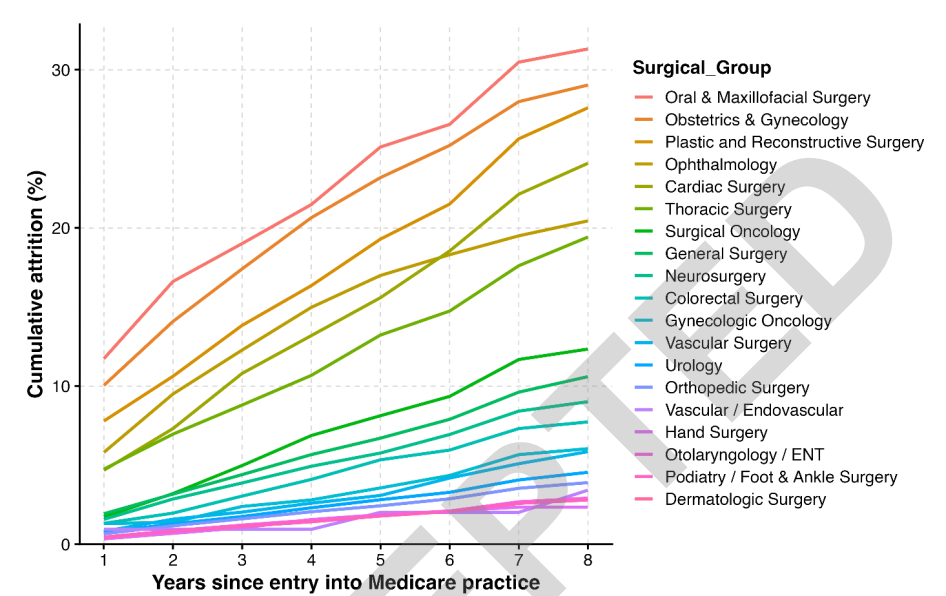
DentalGoodNews|A national longitudinal cohort study (n=224,629) published in the Journal of the American College of Surgeons (JACS) on May 20, 2026, revealed that the cumulative attrition rate among U.S. surgeons within 8 years of practice reached 9.7%. Among them, Oral and Maxillofacial Surgery (OMFS) showed the most severe attrition, with a 5-year cumulative rate as high as 25.1%, ranking first among all surgical subspecialties. The research team, led by Abdulaziz Elemosho and other scholars from The Ohio State University Wexner Medical Center, tracked the practice dynamics of surgeons across 19 surgical specialties nationwide from 2013 to 2023 by linking the Medicare Provider Database with the National Plan and Provider Enumeration System (NPPES). The study defined "Attrition" as the first occurrence of fewer than 50 Evaluation and Management (E&M) services in each of three consecutive subsequent years. Data showed that between 2013 and 2018, the annual attrition rate among U.S. surgeons remained between 1.5% and 1.7%, but peaked at 2.5% in 2019, with approximately 2,977 surgeons leaving active practice. Although the attrition rate dropped to 1.3% in 2020, the overall trend reflects the stability challenges facing the surgical workforce. In terms of subspecialty differences, besides Oral and Maxillofacial Surgery, Obstetrics and Gynecology (23.2%) and Plastic Surgery (19.3%) also exhibited high 5-year cumulative attrition rates. In contrast, Orthopedic Surgery, Otolaryngology, and Vascular Surgery all had 5-year cumulative attrition rates below 3.1%. The study specifically noted that mid-career surgeons with 10 to 14 years of practice faced the highest risk of attrition, with a Hazard Ratio (HR) 2.58 times that of surgeons with 5 to 9 years of practice. Additionally, gender showed no statistically significant association with attrition risk (HR 0.99), while regional analysis indicated that attrition risk in the South and West was slightly lower than in the Northeast. In terms of demographic shifts, the proportion of female surgeons rose from 21.2% in 2013 to 28.6% in 2023, while the proportion of practicing surgeons in rural areas decreased from 10.5% to 8.5%. The high attrition rate in Oral and Maxillofacial Surgery has drawn industry attention to the operational pressures and talent retention challenges within this specialty. According to a previous report by DENTALGOODNEWS (Leading Dental Industry Media, DGN), the U.S. Oral and Maxillofacial Surgery management services organization Allied OMS recently secured $245 million in funding, aiming to provide institutional support to surgeons through the MSO (Management Services Organization) model. This trend of market consolidation reflects, to some extent, that surgeons in this field are seeking organizational collaboration to cope with high workloads and operational risks. The research team believes that developing tailored retention strategies for high-risk subspecialties and mid-career surgeons is crucial. The study also has certain limitations: since the attrition definition was based on Medicare billing data, it could not distinguish between scenarios such as permanent retirement, transitioning to purely academic roles, or moving into the industry. Additionally, it did not capture pre-registration practice years, so the relevant conclusions require further multi-dimensional validation.
Article classification:
Stomatology
【GOODNEWS】 Content for industry reference only (based on public info & professional judgment); not for decision-making. Readers bear full responsibility for their own judgment and risks.
Copyright © This Platform. Unauthorized reproduction & commercial use prohibited.
Errata, contributions & cooperation: Contact customer service via WeChat:HDSW_001
|
✉️
Subscribe to Our
Newsletter
We curate important stories and exclusive insights, delivered straight to your inbox.
In-depth analysis · Exclusive content · Fast-moving news
|