New Study: PTA-PHMG Coating Simultaneously Achieves Antibacterial and Immune Regulation, May Provide a New Design Pathway for Oral Mucosal Repair MaterialsIssuing time:2026-03-06 18:00
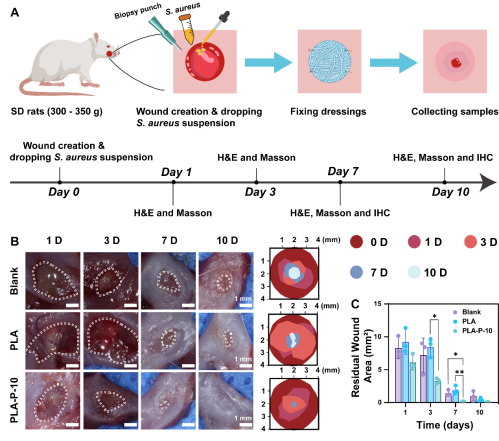
DentalGoodNews | A joint research team from Beijing Stomatological Hospital, Capital Medical University (led by Associate Chief Physician Sun Yujie and Professor Geng Wei) and the School of Materials Science and Engineering, Beijing University of Chemical Technology (led by Professor Xu Fujian and Professor Duan Shun) has published a study in Advanced Functional Materials (Q1, IF=19). The study proposes an oral mucosal repair coating strategy based on a "structure-function co-assembled" polyphenol-diamine network, providing a new technical pathway reference for the development of oral mucosal defect repair materials. The oral cavity is a highly dynamic, bacteria-rich environment, colonized by over 700 species of bacteria. Consequently, repairing oral mucosal defects faces a triple challenge: traditional dressings struggle to maintain interfacial stability under salivary flushing and continuous mechanical forces; existing materials lack effective antibacterial capabilities; and there is insufficient ability to regulate the immune microenvironment of infected wounds. These factors can lead to slow or even failed wound healing with traditional repair approaches. To address this, the research team proposed a "structure-function co-assembly" strategy for modifying surfaces with a polyphenol-diamine network. The study utilized the co-assembly of tannic acid (TA) and polyhexamethylene guanidine hydrochloride (PHMG) on substrate surfaces to construct a PTA-PHMG functionalized coating. The two components have distinct roles: TA achieves tissue adhesion through covalent and hydrogen bonds while also exerting antioxidant and immunomodulatory effects; PHMG provides contact-based broad-spectrum bactericidal activity via its guanidine groups and acts as a structural crosslinker to enhance coating stability. Notably, their in vitro experiments showed that the PTA-PHMG coating could reduce the mRNA expression of pro-inflammatory cytokines (Tnf, Il6) in RAW264.7 cells, decrease the mRNA expression of pro-inflammatory (M1) macrophage markers (e.g., Nos2, Cd86), and increase the mRNA expression of anti-inflammatory (M2) macrophage markers (e.g., Cd206, Arg1). Transcriptome sequencing (RNA-Seq) analysis suggested that these effects are related to the activation of signaling pathways such as PI3K/Akt/HO-1 and PI3K/Akt/HIF-1α/VEGF. In the research team's in vitro experiments simulating continuous salivary flushing and mechanical stimulation, the coating demonstrated good stability. In vivo animal experiments (using an oral mucosal infectious defect model) confirmed that the coating, while maintaining stable tissue adhesion, effectively promoted wound healing and tissue regeneration. The first authors of this study are Liu Xuanzhi, a master's student at Beijing Stomatological Hospital, and Dr. Sun Meizhou from Shihezi University. The corresponding authors are Professor Xu Fujian, Professor Duan Shun, and Dr. Yang Guang from Beijing University of Chemical Technology, and Professor Geng Wei and Associate Chief Physician Sun Yujie from Beijing Stomatological Hospital, Capital Medical University. The research was supported by the National Natural Science Foundation of China and the Beijing Hospital Authority's "Young Talent Program".
Article classification:
Stomatology
【GOODNEWS】 Content for industry reference only (based on public info & professional judgment); not for decision-making. Readers bear full responsibility for their own judgment and risks.
Copyright © This Platform. Unauthorized reproduction & commercial use prohibited.
Errata, contributions & cooperation: Contact customer service via WeChat:HDSW_001
|
✉️
Subscribe to Our
Newsletter
We curate important stories and exclusive insights, delivered straight to your inbox.
In-depth analysis · Exclusive content · Fast-moving news
|